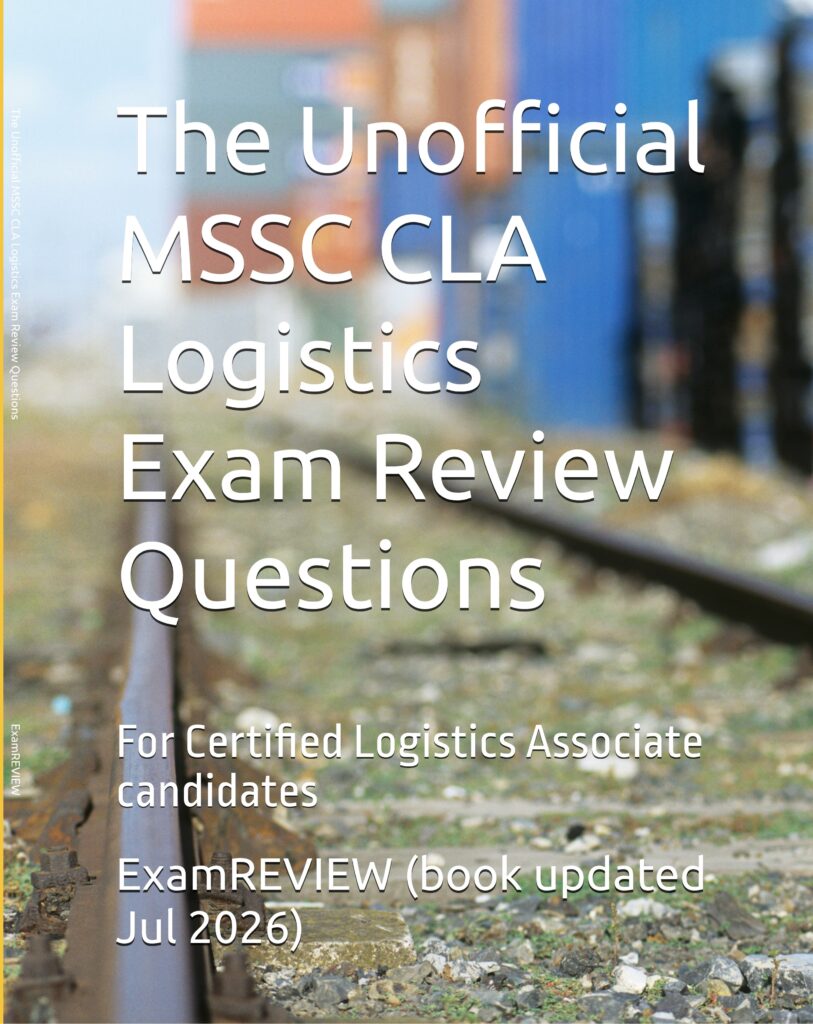
Book updated Jul 2026.
The Manufacturing Skill Standards Council (MSSC) offered a certification called “Certified Logistics Associate” (CLA) as part of their Certified Logistics Technician (CLT) program. The CLA exam is designed to assess the foundational knowledge and skills of individuals in the field of logistics and supply chain operations.
The CLA certification is ideal for individuals who are new to the logistics industry or looking to enhance their understanding of the supply chain processes. The certification aims to validate the candidate’s competence in fundamental logistics tasks and principles. MSSC has updated its foundational CLA exam to a new CLA 4.0 version, which represents a comprehensive modernization of both the curriculum and the certification’s underlying body of knowledge to reflect the latest requirements for entry-level positions in logistics, manufacturing, and supply chain operations, and this credential serves as a prerequisite for the more advanced Certified Logistics Technician certification. The content of the CLA exam covers a range of essential logistics topics, including demonstrating an understanding of the global supply chain logistics life cycle, the logistics environment, operating and using equipment, practicing safety principles in materials handling and equipment operation, practicing quality control principles, employing work communication practices, practicing teamwork and good workplace behavior to solve problems, and using relevant computer systems and applications to increase productivity, and these topics are structured around core competencies such as the global supply chain lifecycle, material handling, safety, quality, communications, and information technology.
We create these self-practice test questions module referencing the concepts and principles currently valid in the exam. Each question comes with an answer and a short explanation which aids you in seeking further study information. For purpose of exam readiness drilling, this product includes questions that have varying numbers of choices. Some have 2 while some have 5 or 6. We want to make sure these questions are tough enough to really test your readiness and draw your focus to the weak areas. Think of these as challenges presented to you so to assess your comprehension of the subject matters. The goal is to reinforce learning, to validate successful transference of knowledge and to identify areas of weakness that require remediation.