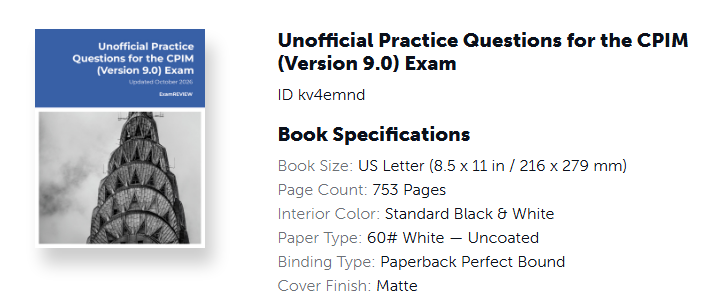
ASCM CPIM Certification program uses a single-exam format (CPIM 9.0), replacing the older two-part (Part 1 and Part 2) structure. This single examination is rigorous. This book provides a comprehensive collection of unofficial practice questions designed to supplement your study efforts. Each question is modeled after the style, format, and difficulty of the CPIM exam and is accompanied by a detailed explanation of the correct answer, all intended to help you build the confidence and competence needed to succeed.
Note: This is an independent study resource and is NOT affiliated with, endorsed by, or sponsored by APICS.
The APICS Certified in Planning and Inventory Management (CPIM) is widely recognized as the standard credential for professionals who manage the engine room of supply chain operations: demand, sales and operations planning, master scheduling, material requirements planning, capacity, inventory, and detailed scheduling. The current version, CPIM 9.0, represents the most significant structural update to the program in years, having gone live on June 1, 2026, following a comprehensive job task analysis conducted by the Association for Supply Chain Management (ASCM) with input from over 1,800 industry professionals globally. If your work involves balancing supply against demand, this certification validates the practical knowledge that makes those plans executable.
The transition to CPIM 9.0 reflects an intentional sharpening of focus on planning and scheduling while modernizing the treatment of supply sources. The most notable structural change is that the previous single “Plan and Manage Supply” domain has been split into two distinct modules: Plan and Manage Internal Supply Sources and Plan and Manage External Supply Sources. The internal supply module is now the largest learning component, covering master scheduling, capacity planning, MRP, and the management of changes and disruptions, while the external supply module carries refreshed content on procurement, supplier risk, sustainability, and reverse logistics. This split acknowledges that the skills required to orchestrate internal production and the skills required to manage external supplier relationships are distinct competencies that deserve dedicated attention. The remaining seven modules address strategy alignment, S&OP, demand management, inventory, detailed scheduling, distribution, and quality and continuous improvement.
From a candidate’s perspective, the exam format remains a single computer-based assessment of 150 questions to be completed in three and a half hours, with 130 questions scored and 20 unscored pretest items used for statistical purposes. The exam is scored on a scale of 200 to 350, with 300 required to pass, and it can be taken at a Pearson VUE testing center or online through OnVUE. Questions are designed to test application and understanding rather than rote recall, frequently requiring candidates to select the best of four choices or complete calculations based on the information provided. ASCM recommends approximately 100 hours of preparation, and candidates who sit for the exam within three months of completing their study are more likely to pass.
Because CPIM 8.0 was retired on May 31, 2026, candidates preparing for any exam date from June 2026 onward must study the 9.0 Learning System. Older module notes will not map cleanly to the split supply domains, and ASCM has confirmed that both exam versions will never be live simultaneously. The credential itself is maintained through the submission of 75 professional development points every five years, ensuring that certified professionals remain current with evolving industry practices.